Youth leagues, high school teams, and adult rec sports all ramp up at the same time every August. The gap between summer rest and fall-season demand is exactly where early injuries happen.
Fall is arriving fast in San Jose. Youth soccer leagues are forming rosters, high school cross-country teams are logging their first long runs, and adult recreational leagues are firing back up after a summer that, for a lot of people, meant a lot more sitting on the couch than staying in game shape. That gap between where the body is right now and what a full season of sport demands is exactly where early-season injuries are born. The good news is that gap is usually smaller than it feels — and it is surprisingly straightforward to close with the right attention before the first game or practice.
Why the early weeks of a season carry the most injury risk
Pre-season and the first few weeks of competition are consistently the highest-risk window for musculoskeletal injuries, and the reason is simple: load spikes. A student athlete who spent July sleeping in and going to the pool is suddenly running two hours of practice every afternoon. A weekend rec soccer player who has not sprinted since last spring is now making lateral cuts and shooting with full force. Muscles, tendons, and joints that have not been stressed in months are asked to do a lot, quickly. When they are also working around restrictions — a stiff hip flexor, a thoracic spine that has stopped rotating fully, an ankle that never quite healed from last season — the risk multiplies.
The patterns we see most at season start
The early-season complaints we evaluate most often follow a predictable set of themes. Hamstring strains appear frequently in runners and soccer players whose hip mechanics are off, forcing the hamstring to absorb forces it was not designed to carry alone. Low back pain is common in sports with rotation — baseball, tennis, golf, even swimming — when the thoracic spine is too stiff to contribute and the lumbar spine compensates. Knee soreness tends to show up when the hip is not loading evenly, shifting stress down to the joint below. Shin splints, plantar fasciitis, and ankle issues show up in runners who ramped up mileage too quickly without the foot and lower-leg stability to back it. In most cases the injury site is not where the real problem is.
What a pre-season chiropractic evaluation actually looks at
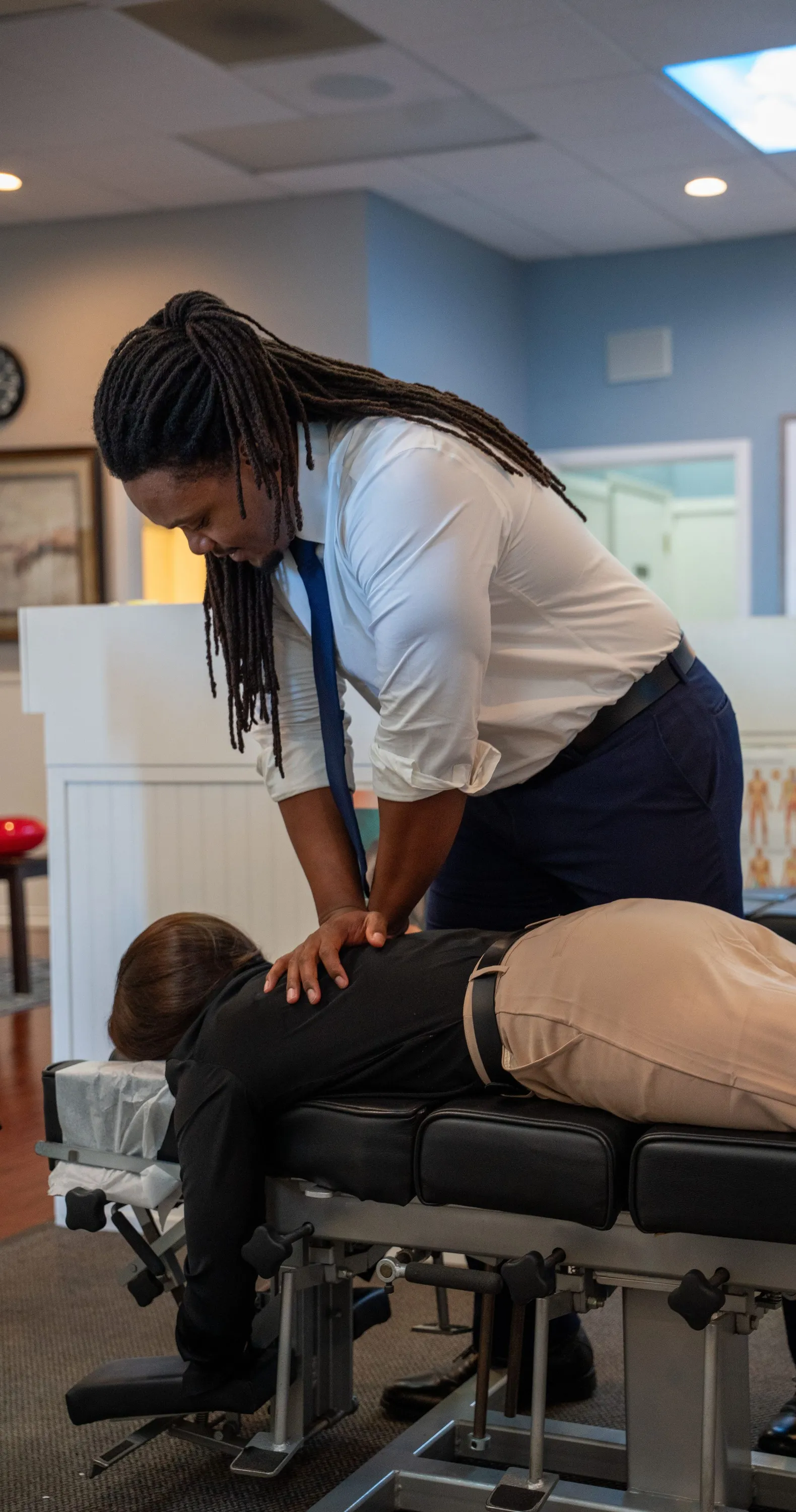
A pre-season evaluation is not just a quick check — it is a chance to see how your body is actually moving before the season puts it under load. We look at how your spine, hips, and shoulders are rotating and loading, identify which joints have restrictions that will force other structures to compensate, and flag movement patterns that are likely to cause problems before they actually do. For student athletes, this kind of evaluation is especially useful because young bodies adapt quickly once restrictions are cleared. For adult recreational athletes, it often uncovers something from last season that never fully resolved — and addressing it now is far less disruptive than addressing it mid-season when it finally speaks up.
Making it through the whole season, not just the first game
Whether you are a parent with a student athlete getting ready for a fall league or an adult who is lacing up the cleats again, the goal is the same: making it through the whole season healthy enough to actually enjoy it. If you are carrying something into fall — a nagging ache, a stiffness that has become the new normal, a movement that just does not feel right — now is a better time to address it than week three when the schedule is packed. Call us at (408) 703-8498 to schedule a consultation at our San Jose office. A short evaluation before the season can make a real difference in how the next several months go.